Chimney Sweep and Repair for Franklin Square's Brick Houses
Franklin Square started out as farmland near the middle of the Hempstead Plains, country that George Washington described in 1790 as almost entirely treeless. The settlement was called Trimming Square and then Washington Square before it took its present name in the 1870s, when it got a post office. By 1952 the last farms had given way to houses, and the hamlet that stands today is made up largely of prewar and early postwar homes on modest, closely spaced lots. Chimney sweep and repair in Franklin Square therefore means looking after chimneys that are, for the most part, three-quarters of a century old or more.
Franklin Square is an unincorporated hamlet in the Town of Hempstead, so there is no village hall to consult. When a job grows beyond cleaning into a rebuild, a new liner or a replacement heating appliance, ask whether a Town of Hempstead building permit applies before it is scheduled. A routine chimney sweep or annual inspection can be booked right away.
What an Old Brick Cape Asks of Its Chimney
Cape Cods from the early postwar years are a familiar sight on Franklin Square's side streets. Many have a single masonry chimney with two flues inside: one for the living-room fireplace, one for the boiler or furnace in the basement. Both are often still lined with the original clay tile. After many decades of heating seasons, those tiles develop cracks and open joints that cannot be seen from the firebox, and the cement crown at the top has often been patched more than once.
Plenty of these Capes have also been expanded, and a full dormer or a raised roof changes how the chimney sits against the house. NFPA 211 calls for a chimney to rise at least 3 feet above the point where it leaves the roof and at least 2 feet above any part of the building within 10 feet. A chimney top that met that rule when the house was new can fall short after an addition, and the telltale sign is a fireplace that smokes on gusty days. A chimney inspection checks the height against the current roofline along with the condition of each flue.
Close-Set Houses and Hard-Working Brick
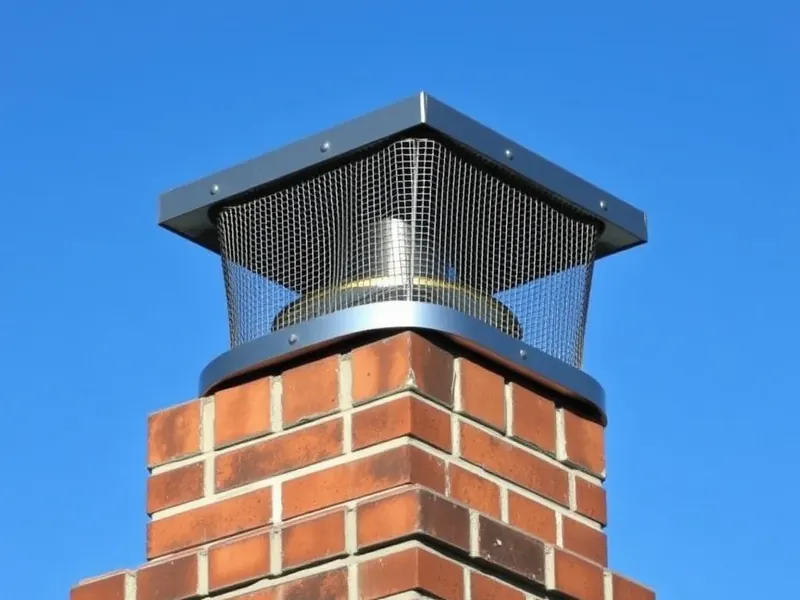
On a narrow lot the house next door is only a few steps away, and that shapes how chimney work gets done here. Ladders often go up in a narrow side yard, debris has to stay off the neighbor's driveway, and smoke from a fireplace that draws poorly can drift toward the windows next door. A sturdy cap with mesh sides stops sparks from leaving the flue and keeps animals from getting in, and a crown with a real overhang throws rainwater clear of brick that may stand only a few feet from the neighbor's siding.
The brick itself needs attention too. Older brick soaks up rain, and every Long Island winter freezes that moisture inside the wall again and again. Flaking brick faces near the top of the stack, white staining and mortar you can scrape out with a key are the early signs. Repointing with mortar matched to the old brick, and rebuilding only the courses that have actually failed, keeps the chimney sound without replacing more masonry than necessary. The tuckpointing and chimney rebuilding page explains how that work is done.
Heating Flues and Late-Night Calls in Franklin Square
In this part of Nassau County, many chimney emergencies start in the basement rather than the living room. A boiler flue choked by fallen tile, soot or a nest can push carbon monoxide back into the house, and an old flue that suddenly serves a new high-efficiency boiler can fill with condensation. If a CO alarm sounds, get everyone outside and call 911 first, then call about the chimney. 1stCall Emergency Chimney answers at any hour, and Franklin Square is a short drive south of Manhasset: New Hyde Park Road runs south to the hamlet and becomes Franklin Avenue where it crosses Hempstead Turnpike.
Once the house is safe, the next steps are a camera look at the full flue and a written estimate, the same starting point as any planned chimney sweep and repair in Franklin Square. Where the tiles have failed, a stainless steel chimney liner listed to UL 1777 and sized to the appliance restores a sealed path for the exhaust.